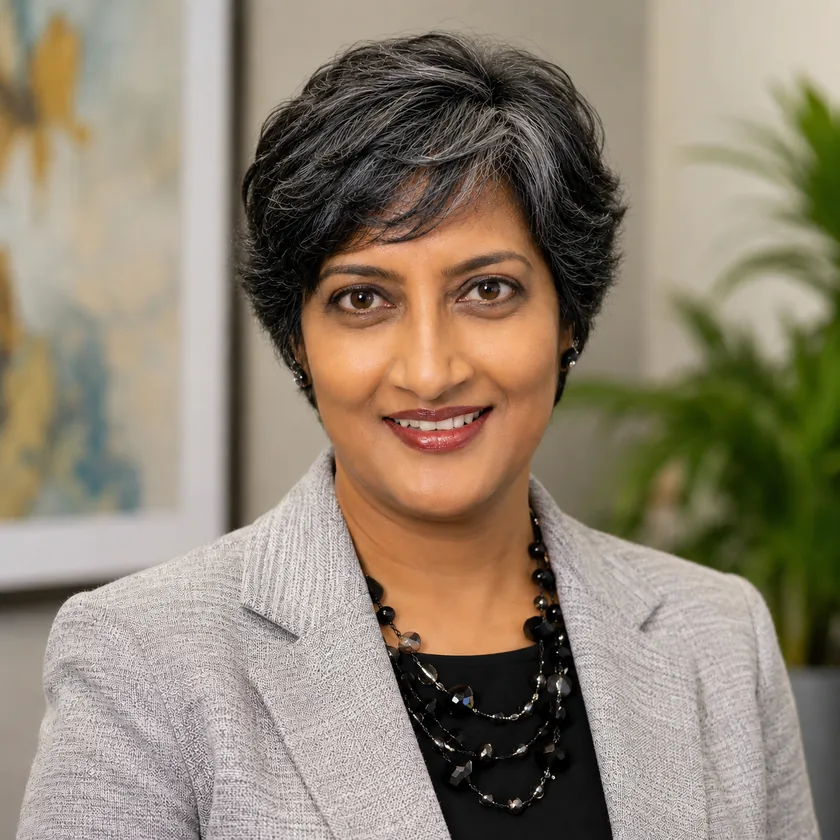
About Jyoti Agrawal
Jyoti Agrawal is a business strategist and scientist in Lexington, Kentucky. Her PhD in chemical engineering came from the Indian Institute of Technology Bombay in 2004, followed by a postdoctoral year at INRIA in France. Ten years after that she went back to school for an MBA at the University of Chicago Booth School of Business. Her working life has moved from the laboratory to the balance sheet and back ever since.
Industry came first. At Maricopa County, Arizona she was Energy Manager, where conservation work at county facilities saved more than a million dollars a year and she wrote the energy policy and procedures behind it. At Intel she was a gas system engineer in Phoenix, responsible for delivering high purity bulk gases to factory tools and for energy management and LEED certification work at the Ocotillo campus.
In 2007 she founded her own science and technology consulting practice and ran it for the next seventeen years, on federal, state, and corporate projects in advanced materials, renewable energy, semiconductor devices, and inspection technology. The work ran from concept to design, processing, packaging, characterization, and technology transfer, usually with a team of three to five engineers. Five Small Business Innovation Research contracts came out of that period, and she developed and managed the grant-funded programs attached to them.
More than fifteen peer-reviewed publications carry her name, in Chemical Engineering Science, Nonlinear Dynamics, and Chemical Engineering Research and Design, along with one issued patent. In 2021 she consulted at Florida Atlantic University, advising startup businesses on federal contracting, operational planning, and growth strategy. A certified National Science Foundation I-Corps instructor, she founded Xaiden Arts & Business Consulting in March 2025.
Most organizations fail because they answer the wrong question exceptionally well.Jyoti Agrawal
Distinctions
-
First place, Global New Venture Challenge
Polsky Center for Entrepreneurship and Innovation, University of Chicago Booth School of Business, 2016, against a field of five hundred.
-
Named inventor, United States patent
Quantitative secondary electron detection: measuring low energy electrons and X-rays below 100 electronvolts. Corresponding filings in Japan, South Korea, India, and the European Union.
Practice
Business planning and strategic growth
Where the organization is going, and which of the obvious next steps is the right one.
Grant and proposal development
Federal and foundation funding, from capture planning through submission.
Commercialization and market strategy
Customer discovery, product-market fit, positioning, and pricing.
Startup and small business consulting
A plan founders can run on Monday rather than a deck they never open again.
Business model development
How the money moves, who pays whom, and whether the arithmetic survives year two.
Executive, leadership, and career coaching
One-to-one work with professionals in transition.
Market research and competitive analysis
How the market looks from outside, and where the room to move is.
Technical and business writing
Proposals, specifications, reports, and plans that are right and readable at once.
The Convergence Method
Market studies usually run top down and customer interviews run bottom up, and in most organizations the two never meet. Convergence puts them in the same room on purpose.
Market data sets the outer boundary of what is possible. Interviews with real buyers tell you which part of that space someone will actually pay for. Where the two agree is where a durable advantage lives, and it is the only part worth writing a plan around. Everything else is a guess wearing a spreadsheet.
In practice it means the first weeks of an engagement are spent listening rather than building. It is cheaper to be wrong in a conversation than in a product launch, and far cheaper than being wrong in a grant application.
Selected Work
-
Quantitative Secondary Electron Detection
Sensors that quantify ultra-low energy electrons and X-rays below 100 electronvolts. The project carried Phase I, Phase II, and Kentucky Science and Technology Corporation matching support, and produced operational prototypes built by a team of three to five engineers, covering circuit design, layout, and processing of a CMOS device array along with its control circuitry. Patent filings followed in the United States, Japan, South Korea, India, and the European Union.
-
NSF I-Corps, 150 interviews
Before committing to a design, the team interviewed 150 customers, end users, decision makers, and scientists to establish the market, the price, the ecosystem, and the business model. That work became the Global New Venture Challenge entry that took first place at the University of Chicago in 2016.
-
BOND-M, a DARPA SBIR
Secured, managed, and executed the design of an ultrasonic phased array system for inspecting aerospace grade laminated composites and their joints.
-
Low cost silicon carbide composites
A prototype manufacturing process for silicon carbide composites built on field assisted sintering, developed to run at under twenty percent of the cost of the conventional process.
Record
Education
- PhD, Chemical Engineering, Indian Institute of Technology Bombay, 2004
- MBA, University of Chicago Booth School of Business, 2017
- Postdoctoral researcher, INRIA, France
Teaching
- Certified NSF I-Corps instructor
- More than forty-five startup teams coached in customer discovery at the Florida Atlantic University Small Business Development Center
Research
- More than fifteen peer-reviewed publications
- Chemical Engineering Science, Nonlinear Dynamics, Chemical Engineering Research and Design
- Scientific computing at INRIA and Wolfram Research
Earlier recognition
- Second place, business plan competition, PAN IIT Global Conference, Houston, 2013
Certifications
- Google Project Management Certificate, 2026
- Foundations of Project Management, Google, 2025
Prior roles
- Founder and CEO, science and technology consulting practice, 2007 to 2025
- Business Consultant, Florida Atlantic University
- Gas System Engineer, Intel Corporation, Phoenix
- Energy Manager, Maricopa County, Arizona
Sectors
- Advanced materials and manufacturing, semiconductors, clean and renewable energy, biotechnology, artificial intelligence, government contracting, universities and research, nonprofits
Arts
The consulting practice is one half of the business. I also work as a crochet designer and pattern developer, making original designs, written patterns, and finished products.
Writing a crochet pattern turns out to be specification work. Every stitch is counted, every round is tested, and the whole thing has to be legible to a stranger who has nothing but the page in front of them. The discipline is the same one I bring to a proposal or a technical document, and the failure mode is the same too: if the reader has to guess, the writer did not finish the job.
I keep the two halves running because analytical problem solving and creative expression do better in the same building than in separate ones.